The Textiles Ministry has demanded sops for the yarn and fabric sectors, which it says were ignored in the five-year Foreign Trade Policy announced early this month.
It has also made a case for inclusion of garments in the interest subvention scheme being finalised by the Commerce Ministry to help the sector compete with Vietnam, Sri Lanka and Bangladesh, which get favourable access to developed markets.
“Officials from the Textiles Ministry have already held preliminary discussions on the matter with officials in the Commerce Ministry and the Directorate General of Foreign Trade. We have forwarded all the complaints that we had received from the industry. The Secretaries from the two ministries are also in touch,” an official told BusinessLine .
Flawed incentives
Man-made fibre yarn as well as woven and knitted fabrics, in addition to garments, have been extended a 2 per cent incentive (in the form of fully transferable duty scrips) in the EU, the US, Canada and Japan. However, sops in these markets do not help yarn and fabric producers as they export very little to these markets. The Merchandise Export Incentive Scheme (MEIS), however, ignores markets such as China, Bangladesh, Sri Lanka, Turkey, Vietnam and South Korea, which are major destinations for yarn and fabric from India.
“By excluding key markets, the policy has virtually ignored fabric and yarn producers, who also need support in the shrinking world market,” the official said.
The Textiles Ministry is also trying to persuade the Commerce Ministry to include garments and other sectors in the new interest subvention scheme being finalised by it. Under the scheme, exporters from select sectors will get credit at a 3 per cent subsidy for the next three years.
“The garments sector is facing a tough time competing with smaller economies such as Vietnam, Sri Lanka and Bangladesh, which get preferable access into the EU and US markets. Interest-rate subvention will give it some relief,” the official said.
The textile sector is the largest employment generating sector in the country, especially for low-skilled workers, and needs to be supported, he added.
The Merchandise Export Incentive Scheme ignores markets such as China, Bangladesh, Sri Lanka, Turkey, Vietnam and South Korea, which are major destinations for yarn and fabric from India.
(This article was published in the Business Line print edition dated April 29, 2015)
Wednesday, April 29, 2015
Textiles Ministry seeks export sops for yarn, fabric sectors
Tuesday, November 12, 2013
Government likely to double export target to $1 trillion
NEW DELHI: The government is expected to double the export target to $1 trillion in the next five-year foreign trade policy even though the current policy that runs until March 2014 is all set to miss the $500-billion target set for exports.
A senior commerce department official told that the government has begun work on the foreign trade policy for 2014-2019, which will aim at doubling India's share in global trade from the current 3%. The policy is, however, expected to be announced only after the new government assumes office after the general elections next year.
"After the very successful 2009-14 foreign trade policy, we have started working towards the policy for the next five years," the commerce department official said. "Consultation process has started for that. We want to focus on the high-value exports and import substitution, such as engineering, aeronautics, cars, where value addition is the highest."
The proposed 2014-19 policy would include measures to make the country's outbound shipments more competitive by boosting productivity and generating exportable surplus.
"It will require support from the government to provide support for marketing, export infrastructure including improved logistics, keeping in mind the current situation of CAD (current account deficit)," said an inter-ministerial note moved for consultation on the new policy.
People aware of the consultations said the government is likely to set the export target for the new policy at around $1,000 billion.
The inter-ministerial note also explains the proposed policy would include a long term and a medium-term strategy to enhance trade competitiveness and overall growth of India's foreign trade.
Since 2009, India's exports have nearly doubled from $178 billion in 2009-10 to about $325 billion. The foreign trade policy for 2009-14 provided fiscal incentives to traditional sectors in the form of interest subvention and other duty neutralisation schemes to provide refund of indirect taxes and levies.
It focused on export promotion of capital goods and market diversification and product diversification. Incentives were provided under focus product and focus market schemes to encourage exporters to explore markets like Latin America and Africa.
The share of exports to Latin America has gone up from 2.9% in 2008-09 to 4.5% in 2012-13. India's rising current account deficit has prompted the government to promote import substitution through the new policy. India's CAD widened to a record high of 4.8% of the GDP in 2012-13 and 4.9% of the GDP in the first quarter of the fiscal.
After remaining muted for a year, India's exports grew in double-digits in the three months starting July, expanding by 11.2% in September.
Friday, October 14, 2011
Exporters get Rs 900 crore relief package
NEW DELHI: The government on Thursday announced a Rs 900-crore package for exporters to help them tide over the slowdown in developed markets and rising input costs. RBI has already announced interest subsidy of 2% on rupee export credit for handicrafts, handlooms, carpets and small and medium exporters. Along with the interest subsidy the total relief package for exporters stands at nearly Rs 1,700 crore.
Sectors which would benefit from the government move on Thursday include engineering goods, pharmaceuticals and chemicals, apparels and others. Commerce minister Anand Sharma unveiled a special focus market scheme, which would help diversify the country's exports to new markets. Under the scheme, an additional 1% duty credit would be provided to exporters, who ship their goods to markets in Latin America, Africa and CIS countries. The total number of countries in the scheme is 43 and includes new entrants Cuba and Mexico.
"These are not easy times for the exporting community. The shroud of economic uncertainty still envelopes the global economy. The troubles which began with a sovereign debt crisis in Europe last summer continue and still linger. Actually things have become even more serious thereby sapping both business and consumer confidence in one of our largest markets - US. We have to ensure that export growth continues," Sharma said. The commerce ministry has undertaken a series of measures to open up new markets to counter the slowdown in the country's traditional markets like US and EU.
"My guess is in a ballpark range, excluding interest subvention, it will be roughly around Rs 800-900 crore. For interest subvention it will be around Rs 800-Rs 1,000 crore... roughly about Rs 1,700 crore," commerce secretary Rahul Khullar said when asked about the total outgo on the schemes.
Fifty products in engineering, pharmaceuticals and chemicals would get special bonus of additional 1% of export value between October and March in the current financial year. "It is a Diwali bonanza. We were not expecting this much," said Ramu Deora, president of the Federation of Indian Export Organisation (FIEO).
Sharma also said the government had set up a panel comprising the finance secretary, commerce secretary, and secretary financial services which would address the issues of availability of dollar credit. "I have discussed the issue with the finance minister and we will ensure continued availability of dollar credit," he said.
The commerce minister was confident of meeting the $300 billion target for exports set for 2011-12. But he said the global economic slowdown posed a tough challenge. Exports are estimated to have risen 52% to $160 billion in the first half of the current financial year on the back of robust performance from engineering goods and petroleum products.
Industry groups cheered the move saying it would help Indian exporters in the current challenging global environment. "Additional benefits in terms of Special Focus Market Scheme, Special Bonus Benefit Scheme and support to apparel sector would be vital in stepping up the competitiveness of our exports," said Rajiv Kumar, secretary general of Ficci.
Friday, September 16, 2011
DEPB Scheme to go on 30th September
NEW DELHI: Tax incentives for exporters will be lowered from Oct 1 as the government said Friday it will do away with the popular tax refund scheme, Duty Entitlement Pass Book (DEPB), and bring them under an existing duty drawback scheme from the beginning of next month.
At the same time, the number of items eligible for the drawback scheme have been increased by 1,100 to take the number of eligible items to 4,000.
After unveiling a transitory scheme for the 14-year old DEPB scheme, Finance Secretary R.S. Gujral said tax refunds on exports of 2,130 items will be reduced by 1 to 3 percent.
"An endeavour has been made to soften the reduction and transition from the DEPB to duty drawback scheme," Gujral told reporters.
Exporters of engineering, chemical, pharmaceuticals, marine and textile products are the major beneficiaries of DEPB scheme. Tax refunds under DEPB scheme resulted in the revenue loss of Rs.8,700 crore to the government exchequer last fiscal.
The revenue loss would be reduced significantly due to the replacement of the DEPB scheme, said Chairman of Central Board of Excise and Customs S.D. Majumdar.
The reduction in tax incentives might affect the growth of exports.
India's exports jumped 54.2 percent at $134.5 billion in April-August period, led by a sharp increase in exports of engineering goods.
Officials said the government will shortly notify "all industry rates" of duty drawback for the current fiscal.
The government had constituted a committee in January under Planning Commission member Saumitra Chaudhuri for formulating the "all industry rates" duty drawback.
The committee recently submitted its report.
"Recommendations of the committee form the basis for the rates being notified," the finance ministry said in a statement.
"The DEPB Scheme has been in existence since 1997. Presently, there are 2,130 line items covered under this scheme. Incorporating these items within the drawback schedule and assigning appropriate duty drawback rates for these items was a challenge both from a product classification perspective as well as from a drawback rate perspective," an official statement said.
"Consequently, the new drawback schedule will incorporate an additional 1,100 line items(approx.) which are being taken from the DEPB list. With this, the total number of items in the drawback schedule will number approximately 4000 line items, as against the present 2835 line items," the statement added.
Most items which are already covered under the duty drawback scheme will suffer a minor reduction in the existing rates.
"The reduction is mainly on account of the reduction in basic customs duty on crude petroleum from 5 percent to nil as well as a reduction in central excise duty on diesel from Rs.4.40 per litre to Rs.2.40 per litre," a finance ministry statement said.
Tuesday, January 19, 2010
Budget may scrap DEPB scheme
Read More......
Friday, September 4, 2009
Duty Drawback and Entitlement schemes are incentives: SC
The Supreme Court has said profits derived from the Duty Entitlement Passbook Scheme and the Duty Drawback Scheme are incentives and cannot be termed as profits from business to claim income tax deductions.
A bench headed by Justice S H Kapadia dismissed a batch of petitions filed by various firms and held that the duty drawback receipt/DEPB benefits are incentives that flow from government schemes and the Customs Act, and therefore are not profits derived from the eligible business under Section 80-IB of the Income-tax Act, 1961.
"In our view, DEPB/Duty Drawback are incentives which flow from the schemes framed by the Central government or from Section 75 of the Customs Act 1962, hence incentive profits are not profits derived from the eligible business under Section 80-IB. They belong to the category of ancillary profits of such undertakings," the court said.
Stating that DEPB was an "export incentive," the bench said it was given under the Duty Exemption Remission Scheme and to neutralise the customs duty payment on the import content of export product and the neutralisation was provided for by credit to customs duty against export product.
"We are satisfied that the remission of duty is on account of the statutory/policy provisions in the Customs Act/Schemes framed by the Governmnet of India. In the circumstances, we hold that profits derived by way of such incentives do not fall within the expression 'profits derived from industrial undertaking' in Section 80-IB," Justice Kapadia writing the judgement for the Bench stated.
According to Justice Kapadia, duty drawback, DEPB benefits, rebates, etc cannot be credited against the cost of manufacturing of goods debited in the Profit & Loss account for purposes of Section 80 IA/80-IB as such remissions (credits) would constitute independent source of income beyond the first degree nexus between profits and the industrial undertaking.
Thursday, August 27, 2009
New FTP sets $ 200 billion export target
NEW DELHI: Exporters, especially those from labour-intensive sectors such as textiles, gems & jewellery, marine, handloom and leather, have
been handed yet another basket of incentives to increase their competitiveness in the shrinking world market.
The foreign trade policy (FTP), announced by commerce and industry minister Anand Sharma on Thursday, seeks to help exporters establish a stronger foothold in existing markets, make inroads into new markets, upgrade technology through cheaper imports of capital goods, and reduce transaction costs and time through e-filing and lowering of application fees.
The policy—which has set a export target of $200 billion for 2010-11 and talks about doubling exports by 2014—also attempted to build a more stable policy environment by extending a number of existing schemes, including the popular import duty reimbursement (DEPB) scheme and enhanced export credit guarantee cover (ECGC), till the end of the fiscal and beyond.
The incentive package, which follows a number of sops already given in the Union Budget announced earlier this year, however, did not manage to please all. While some exporters contacted by ET welcomed the sops, others felt that the incentives were too little and limited to help make much of a difference on the global front.
“Given the limited incentives provided in the package, it will be very difficult to meet the existing export target of $168 billion. The government should have given more support,” said Rakesh Shah from the engineering export promotion council (EEPC).
Delhi Exporters Association president SP Agarwal said the policy does not live up to exporters’ expectations and will not contribute to stemming the fall in exports. “We have been told time and again that exporters will not have to export taxes. However, nothing was announced in this policy to address issues such as reimbursement of input taxes charged by states and also refund of VAT,” Mr Agarwal said.
Fieo, the umbrella body representing a number of export organisations was, however, more appreciative. “The new policy rightly puts emphasis on market diversification as our traditional exports have been hit badly due to concentration in the US and EU regions. The introduction of zero-duty capital goods scheme will add to expansion and modernisation of the production base,“ Fieo president A Sakthivel said.
Falling in step with competing countries like China, Bangladesh and Pakistan that have recently increased export incentives, the FTP provides higher support for market and product diversification by increasing incentives under focus market and focus product schemes—two independent schemes giving direct incentives to export of select products and to select countries.
The focus market scheme has been extended to 26 new markets, which includes 16 in Latin America and 10 in Asia-Oceania. The government also introduced a new market-linked focus product scheme where incentives will be given to export of select items to 13 identified markets like Egypt, Kenya, Nigeria, South Africa, Tanzania, Australia and New Zealand.
The policy also sought to ensure that dollar credit needs of exporters are met in a timely manner by setting up a committee, including finance secretary, commerce secretary and the Indian Banks Association (IBA) to monitor credit flow.
To help the industry upgrade technology, the policy introduced a scheme for importing capital goods at zero duty for identified sectors like engineering, chemicals, electronic products, pharmaceuticals, textiles, handicrafts, plastics and leather and leather products, subject to an obligation to carry out specified amount of exports. The existing export promotion capital goods (EPCG) scheme allows import of machinery at 3% duty against an export obligation.
Status holding exporters—whose exports are over and above specified levels—will be allowed additional duty credit scrips for import of capital goods for personal use at lower import duties. The discount will be equivalent to 1% of the exports made in the previous year.
The government has also announced continuation of the DEPB scheme beyond December 31, 2009, to December 31, 2010, and the enhanced ECGC cover till March 2010. The extension will help exporters in taking pricing decisions over an extended period of time.
A number of specific sops have been extended to labour-intensive industries such as gems & jewellery, marine, leather and the handloom sectors, which have received the most severe battering due to the global economic crisis.
The FTP has also sought to reduce transaction costs (which account for 5%-7% of total value of exports) and time by introducing a time frame for complete electronic networking of various export related agencies and reducing fees for authorisations and licence applications.
Tuesday, August 18, 2009
Foreign Trade Policy will be announced on August 27
The five-year Foreign Trade Policy (FTP), to be unveiled on August 27, is expected to give incentives to Indian exporters to widen their global markets beyond the US, EU and Japan in the face of the economic crisis in these key destinations.
Commerce and Industry Minister Anand Sharma, who apprised Finance Minister Pranab Mukherjee today about the difficulties being faced by exporters, said: “We will surely look at market expansion because if the diversion and expansion of market is not there, we will not be able to respond to this challenge.”
Talking to reporters after his meeting with Mukherjee, Sharma said the government could extend support but would not be in a position to generate demand in the western economies, which are contracting.
India’s exports are on a downslide since October 2008 and the average contraction has been around 30 per cent over the past nine months. The country’s exports were about $169 billion in fiscal 2008-09.
Sharma indicated that the policy, which outlines the priority sectors as also the sops, would be focused on employment-generating areas like textiles, leather, gems and jewellery, and handicrafts.
These sectors are having a torrid time over the past nine months, as their demand dried significantly in the US and the EU.
Sharma said the policy would ensure that the exporting sectors not only sustain themselves in these difficult times, but also expand into new geographies. It will also ensure that “labour-intensive (sectors) are given special consideration”, he said.
This will be the UPA government’s first FTP in its second term. Earlier, there was uncertainty whether the policy should be long-term or for a single year. However, it will set a five-year road map for exporters.
Tuesday, February 24, 2009
Interim trade policy may make rules easier for exporters
NEW DELHI,: The government is likely to remove several procedural bottlenecks for exporters in the interim foreign trade policy to be unveiled by Commerce and Industry Minister Kamal Nath here on February 26.
The policy, though interim in nature, will address immediate concerns of exporters who are facing shortfall in demand for Indian goods in the recession-hit overseas markets like the US, a Commerce Ministry official said.
Exporters may be given more time to meet their export obligations in return for duty-free import of machinery and reimbursement of taxes without waiting for export proceeds.
The interim measures would be announced as an annual supplement to the five-year policy 2004-09 that was unveiled by the UPA Government at the beginning of its tenure.
The foreign trade policy lists the procedures, incentives for exports as also import rules. Though the policy has a five -year tenure, the government keeps changing the rules depending on the fast-changing trade scenario. For instance, the government had banned export of wheat and other food articles last year in the wake of high inflation.
It would be up to the new government to announce a full- fledged trade policy, the official said.
India's exports would be growing at lesser pace this fiscal as demand in the buying markets is slowing. Exports totalled USD 162 billion in 2008-09.
Saturday, January 24, 2009
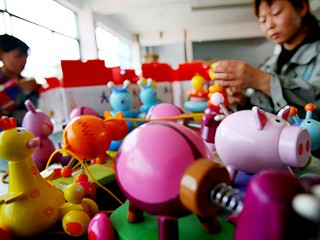
Ban on import of Chinese toys
China's manufacturing industry -- a key supplier of toys, apparel and food to much of the world -- has faced a wave of complaints in recent years, most recently as thousands of people have fallen ill as a result of consuming milk powder tainted with melamine, a chemical used to make plastics.
New Delhi, Jan. 23- The Centre on Friday banned the import of toys from China with immediate effect for six months.
The Director General of Foreign Trade issued a notification banning the imports of toys from China but did not give any reason as to why this was being done.
While the government notification did not cite the reason for the ban, sources said it was concerned over a rise in imports of toys.
A concern had also been raised over the safety of children playing with the Chinese toys, which were found to be toxic.
Most of the varieties, including wheeled toys, dolls, stuffed toys, toyguns, wooden and metal toys, musical instruments, electric trains and puzzles are covered under the ban.
The Toy Association of India's president, Raj Kumar, said the ban would severely hit imports of Chinese toys, but Indian authorities had likely taken the step in the interest of the economy.
"You see Chinese toys everywhere. The good, upper-end toys are made in India, but the cheap toys in the street and small shops were being dominated by them. They are bringing in toys without safety norms," he said.
Kumar said there had been some discussions between toy manufacturers and the government about increasing import taxes on Chinese toys, but he was not expecting a ban.
Another trade official, who did not want to be identified, said the ban may even hit imports of toy components.
"These components are used by Indian companies to make toys. Some companies that have no manufacturing facility, they only import. What will happen to them. This news has come suddenly. I'm really surprised," he said.
In the face of global downturn, Indian industry has been clamouring for protection from aggressive Chinese manufacturers.
Industry officials said there has been a surge in the import of handicraft and toys by Rs 1,000 crore during April -November 2008.
However, trade expert Arun Goyal said, "The ban would encourage smuggling of toys through Nepal borders. That would be more dangerous... It is bad, especially for the slum children, who an afford the cheap Chinese toys only."
The world's leading toymaker Mattel recalled over 21 million Chinese-made toys worldwide in 2007 due to excessive levels of lead paint and other unsafe components. Also that year, China suspended export of a bead toy that was contaminated with a "date rape" drug, Chinese media reported. Some children who swallowed the beads vomited and lost consciousness.
Saturday, December 6, 2008
Exporters may get back benefits available earlier
The big export relief measures for which the besieged exporters are looking forward to on Saturday would largely comprise restoration of benefits already bestowed on exporters that were withdrawn in recent period such as interest subvention, due payment of arrears of terminal excise duty (TED)/Central Sales Tax (CST), services tax and higher drawback and DEPB (duty entitlement pass book) rates.
Highly-placed sources said that the export relief measures to be announced tomorrow would broadly cover these aspects so that exporters, reeling under disconcerting drop in overseas orders and high transaction cost, would be left with some flow of funds to salvage the situation.
They said that not a single service tax to exporters has been refunded by way of notification so far even though the intent has been declared widely.
Policy rates
The sources said that as the RBI is all set to announce on Saturday some cuts in policy rates with banks being asked to push down interest cost, exporters must perforce also to hold on to existing markets for which they need “a little bit of stimulus”. The sources said that once a lower policy rate is unveiled by the central bank to be followed by lower interest rate by banks, exporters would also be given an interest subvention on export finance, especially those in the labour-intensive export segment such as textiles, gems and jewellery, marine products, leather of minus 2 per cent that would cost Rs 250 crore in the next four months.
The restoration of drawback and DEPB rates from the recent cuts would cost another Rs 250 crore in the next couple of months, while there would be refund of services tax on output services and foreign exchange commission to benefit the exporters.
They said the arrears of TED/CST running to Rs 600 crore would be settled now, while the Export Credit Guarantee Corporation (ECGC) would be given a backup of Rs 350 crore to extend risk coverage to exporters. The sources said that the Commerce Ministry is worried that Indian exporters have to contend with every other country providing at least one per cent tax rebate to get export orders in a shrinking market and the least the government could do is to help them realise some of the benefits guaranteed to them under the statute.
Ministry perspective
Asked how the Commerce Ministry views the prospects for exports after the relief measures would be put in place tomorrow, the sources conceded that the department has drawn two scenarios—the most optimistic being that overall exports during the current fiscal would register a 10 per cent growth in dollar terms and the least optimistic being that there would be a decline of 4 per cent in export growth of $162 billion the country compassed during 2007-08. They said the exporters have orders only up to January next and the subsequent months would be difficult to sail through.
The sources said that a survey of 121 companies across the country and across industry revealed that job losses estimated was 65,000 in the last three m months and the prediction is that the aggregate job losses in industry due to declining exports and declining demand would be 12 lakh this year.
The sources said that even the Special Economic Zones (SEZs) have been facing difficulty in exports and in places like electronic SEZ at Santa Cruz, the zone authority has informed the officials in the Commerce Ministry that 25,000 less number of casual employees passes do not get picked up. “This is at a time when casualisation and contractualisation of labour has been the most important labour reform imperceptibly supervening in India between 1991 and 2008”, the sources quipped.
To a specific query about any move to diversify markets for exporters, the sources said that India’s exports to the United States and the European Union (EU) account for only 35 to 38 per cent with the remainder going to Africa, East Asia and Latin American countries. “That is why the Ministry has sought higher assistance for focus market and focus market schemes to help exporters send out delegation and mount trade fairs for buyer-seller interface,” the sources added.
Saturday, November 22, 2008
Hot-rolled coil import put under restricted list
Responding to demand made by the domestic steel industry for measures to check cheap imports from China, the government, on Friday, restricted the import of hot-rolled coils which was so far being freely imported.
This means that the item can now be imported only by actual users against licenses issued by the government and traders will no longer be allowed to import.
The move is part of the government’s effort to help the domestic industry deal with the global economic crisis and the slow-down in demand.
A notification issued by the directorate general of foreign trade (DGFT) stated that import policy for the item `hot rolled coils’ will be amended to read as "restricted" instead of free.
Federation of Indian Export Organisations (Fieo) director general said the measure would be a disincentive for imports as traders can no more bring in hot-rolled coils and supply it directly to the domestic industry. “Since only actual users will be given licenses to import, the total import is expected to go down,” he said.
According to Vinod Mittal of Ispat Industries, the government has taken a pro-active decision at an appropriate time and the move will stabilise the domestic steel industry to some extent. “We are even looking at reducing steel prices further to help consumers get better prices. We will start operating at 80% of our capacity (against 50% at present) from January onwards,” he said.
There have been apprehensions about Chinese companies dumping hot-rolled coils in the Indian market. Reports on a possible withdrawal of the 15% export duty imposed by the Chinese government on steel has made the domestic industry even more jittery.
“Since anti-dumping investigations take a long time, the effective and fast way to check cheap imports is by restricting it. This is what the government has done,” an industry source said. More than 90% of India’s steel imports is from China. The government had, earlier, withdrawn export duty on certain iron and steel products to help domestic steel producers.
Sunday, April 13, 2008
Indian exports to gain edge over China in the long run, says Nath
New Delhi, April 12 Indian exports will have a competitive edge over China in the long term as the latter addresses the backlash on its currency on account of the huge trade imbalances with other countries, according to the Union Commerce and Industry Minister, Mr Kamal Nath.
“China is under a lot of pressure on their currency. In the long run, I see the Chinese currency appreciating much more. China is conscious that their huge trade imbalances with other countries are having a backlash and that backlash is already coming on their currency.
“With declared inflation of 10.5 per cent and pressure on their currency, their costing will undergo a change. That’s what makes me confident about India achieving $200 billion exports this fiscal,” Mr Nath said at a CII meeting on foreign trade policy here on Saturday.
He said China would have to remove the “artificiality” in the currency and pointed out that India does not have to do any such thing as there was no artificial peg.
“That’s why we will have the competitive edge,” he said.
Stating that the whole objective of the annual supplement to the foreign trade policy was to continue with the economic momentum in the country, Mr Nath said the main challenge for exporters would be that of occupying space in new markets.
He urged industry bodies including CII and FICCI to submit suggestions on the products and countries that could be included in the ‘Focus Product’ and ‘Focus Market’ schemes.
The annual supplement had announced intent to calibrate the Focus Products and Focus Markets schemes so that some products of high export intensity (not covered under the FPS) but which have low penetration in countries (which are not covered under FMS) would be considered for export incentive as a focus product for that country.
A case in point could be garments exports to the Japanese market.
Meanwhile, official sources said that a Cabinet committee is likely to meet here on Tuesday to consider several measures aimed at taming the surge in steel prices.
Indications are that the committee may consider proposal to ban steel exports and reduction in excise duty on steel.
Cement ban not to affect SEZ supplies: The cement export ban will not be applicable for supplies made to special economic zones, the Commerce and Industry Minister, Mr Kamal Nath, has said.
“We will clarify that the ban does not apply for cement supplies to SEZs,” Mr Nath said at a FICCI meeting here on Saturday.
Earlier in the day, Mr Nath said that the notification on cement exports ban was issued on Friday night.
Saturday, April 12, 2008
No plans of giving up on rebating State-level taxes, says Kamal Nath
New Delhi, April 11 The extension of the Duty Entitlement Pass Book (DEPB) scheme up to May 2009 notwithstanding, the Commerce Ministry has not given up on the plans for formulating a scheme that would also rebate State-level taxes, the Commerce and Industry Minister, Mr Kamal Nath, has said.
“No, we are not giving up the idea of rebating State-level taxes. There are certain issues. We are looking at a new scheme. The Finance Commission has also been tasked to look at trade issues,” Mr Nath told in an interview soon after the announcement of the final annual supplement to the Foreign Trade Policy 2004-09 here today.
The exporting community has for years been demanding that the State-level taxes be rebated to help improve their competitiveness in the international market.
On whether units in the software technology parks of India (STPI) would also get one-year extension of Section 10B benefits, beyond 2009, Mr Nath replied in the negative. “It is only for EOU units that this extension would be applicable,” he said.
The income tax exemption available to 100 per cent EOUs under Section 10B of the Income Tax law is to expire on March 31, 2009. The EOUs have got tax exemption for one more year, beyond 2009.
To curb inflation, the annual supplement has also announced the withdrawal of incentives under promotional scheme on export of cement and primary steel items. For primary steel items, Mr Nath highlighted that the incentives under the Focus Market scheme have been withdrawn. The idea is to discourage exports of primary steel and ensure their availability for the engineering sector.
On why cement exports have been banned, a measure done today and not part of the annual supplement announcements, the Minister said that the move would help augment domestic supplies. With the demand for cement expected to increase during April-June, he said that a ban on cement exports would to some extent improve availability and address the demand–supply mismatch.
On whether the Government plans to ban exports of primary steel or do away with customs duty on steel imports, Mr Nath said that more steps are on the anvil to tame inflation. He however ruled out ban on iron ore exports.
“The cabinet committee will consider appropriate measures on a realistic and holistic basis. I think inflation will be controlled. Production has not gone down in any of the items. State Governments have been urged to take steps so that they can fulfill their part and ensure that there is no hoarding or profiteering,” he said.
To a query on the cost to the exchequer for extending interest subvention by one more year, Mr Nath said that it would be Rs 1,050 crore during 2008-09 and would be passed on to the Reserve Bank of India.
On whether the annual supplement has addressed the issue of transaction cost reduction to the best possible extent, Mr Nath said that “large number of procedural issues had been taken care of. I took care of them in the last three years also”.
Proactive support from Govt key to achieving export target: DGFT
New Delhi, April 11 The annual supplement to the Foreign Trade Policy (FTP) setting out an ambitious 30 per cent export target for the current fiscal in the face of a likely global slowdown would entail not only all the efforts on the part of our exporters but pro-active support from the Government, the Director General of Foreign Trade (DGFT), Mr R.S. Gujral, said today.
In an interview here soon after the policy supplement was unveiled by the Union Commerce & Industry Minister, Mr Kamal Nath, here, the DGFT said that a review of the last year’s export performance reveals that there were specific sectors where there has been a decline in export.
“Significant are those sectors where they are labour-intensive and less import-intensive. Those sectors have obviously been provided additional relief in this policy — whether it is vegetables, fruits or floriculture, additional amounts have been provided.”
Focus market
The Minister also said that Focus Market and Focus Products schemes would be calibrated — some focus markets with 10 of them announced, the incentives would be sought to be calibrated so that some support is provided to the sector which have been hit by the rupee appreciation to seek new markets in these identified countries, he added.
Asked about relief to export segments that had been affected by the rupee appreciation, Mr Gujral said that the average export obligation under Export Promotion Capital Goods (EPCG) scheme would be reduced by the percentage of the reduction in the overall exports if that is beyond 5 per cent. He said there are about 8 to 10 major areas where the exporters would all get the benefits — coffee, cashew, handicrafts, carpets, some silk readymade garments and certain segments of readymade garments such as cotton and plastics where there has been more than 5 per cent decline in exports.
Transaction costs
To a specific query about reduction in transaction cost to trade and industry, the DGFT said that the policy mentions about 25 major measures in this area. In certain areas, specific timeframe is provided where Central Excise/Customs should provide the certification for clearance within 21 days or 30 days. Some additional ports have been notified for the export incentive schemes to reduce transaction cost.
Electronic data interchange
On electronic data interchange (EDI) to bring benefits to exporters reeling under relentless transaction cost, Mr Gujral conceded that the right thing is to have a 100 per EDI interface for all the schemes operated by the Ministry. He said that under DGFT, currently EDI exists only for Duty Entitlement Pass Book (DEPB) scheme.
“There were a lot of glitches in that scheme for a period of 6 to 7 months, those all have been resolved,” he said adding that “we have mentioned in the supplement that two other schemes — Advance Authorization Scheme and EPCG — would be brought under within three months. Obviously all other schemes would take a little longer time. We have not specified a clear target but Focus Product, Focus Market, Vishesh Krishi and Gram Udyog Yojana (VKGY) have been kept in the next phase after we bring in advance authorization an EPCG under EDI mode.”
Procedural simplification
Asked whether he would confidently say that procedural simplification and cumbersome schedules for exporters have been totally done away with, Mr Gujral said, “My response to this is that in normal course, DGFT will not have made any change in procedure/policy in the last 10 months or so I have been there. The tendency is to put changes in the policy. There were close to 50 issues where procedural simplification or resolutions of problems were to be done. I told my officials let us not wait for policy. If exporters face problem, we don’t need to wait for policy and we need to solve them at once. We have done that and the changes announced in the policy today are over and above that”.
He said that the job of the DGFT is to facilitate and to provide an enabling environment and that is what we have done and “I have full confidence in the resilience of our exporters” in compassing the export target set for the current fiscal.
Export oriented units get extension of I-T benefit
New Delhi, April 11 A slew of measures to pep up export of traditional industries hit by the rupee appreciation, major spurs to cut down transaction costs, procedural simplification, extension of the popular duty neutralisation DEPB (Duty Entitlement Pass Book) scheme till May 2009 and also a one-year extension beyond March 2009 in income-tax benefit to 100 per cent export units are outlined in the annual supplement to Foreign Trade policy.
Releasing the final year supplement to the FTA (2004-09) here on Friday, the Union Commerce and Industry Minister, Mr Kamal Nath, announced an export target of $200 billion for the current fiscal, against $155 billion export performance achieved in 2007-08.
He said the achievement fell short by $5 billion due to the effect of an appreciating rupee by more than 12 per cent against the dollar in 2007. If trade in services were added, India’s commercial engagement with the world would be $525 billion, he said.
In order to achieve the export target, Mr Nath announced tax refunds and interest subsidies to a spate of export segments that are labour-intensive in nature such as marine products, leather, textiles and handicrafts and 5 per cent additional duty credit for export of toys and sports goods.
Agri products
For agricultural products, additional duty credit of 2.5 per cent for export under Vishesk Krishi and Gram Udyog Yojana (VKGUY) is provided for export of certain flowers, vegetables and fruits.
In the Focus Market scheme, 10 more countries including Mongolia, Bosnia-Herzegovina, Albania, Croatia, Honduras, Sudan, Ghana, and Colombia were included.
Under the Industrial Park Scheme, it has now been decided to include IT, ITeS and R&D in natural science and engineering as industrial activities allowed in the parks, he said.
While the customs duty payable under Export Promotion Capital Goods (EPCG) Scheme has been cut from 5 per cent to 3 per cent, average export obligation under the scheme for premier trading houses would be calculated based on the average of the last 5 years’ export instead of the extant 3 years. Alongside, reduced average export obligation under EPCG for sectors that have seen decline in exports in the previous year is also announced.
Mr Nath also unveiled a plan , for value-added manufactured products and said the list of products would be notified shortly. The government would also set up an export promotion council for the telecom sector to augment its exports and would also set up hubs for auto parts, drugs, and petroleum and information technology.
Trade outlook
The Minister also declared that the country hoped to take a five per cent share of global trade by 2020, a four-fold spurt in the next 12 years and a growth rate of 25 per cent consistently in the years ahead.
Other measures announced include treating of all electronic data interchange (EDI) ports as single port, reduction in application fee for duty credit scrips and EPCG authorisation, reduction of application fee for importer and exporter code and a joint task force to plan an integrated trade strategy to address structural problems of exporters.
EOUs would be allowed to pay excise duty on a monthly basis instead of consignment basis. To ensure that terminal excise duty and central sales tax refund is made on time, interest at 6 per cent a year is to be paid to the exporter where refund is not made within one month of the due date.
Ministry keen on cost reduction to trade, not seeking sops
New Delhi, April 11; The Commerce Ministry is not seeking sops for exporters but only insisting on reduction of cost to trade and industry that operate in a high-cost economy with a multitude of problems - from high power cost to inadequate infrastructure facilities - that obstruct the flow of goods across the country and out of it.
In an interview on the annual trade policy supplement, the Commerce Secretary, Mr Gopal K. Pillai, said while the port capacity is increasing by 10 to 12 per cent in a year, exports are going up by 20 to 25 per cent and import growth is accelerating. The resultant congestion and other constraints are forcing people to make changes. Suddenly, container terminals are coming up in three months and minor ports are coming up in Andhra Pradesh, Mundra and Pipava, he said adding that some of these ports are handling 50 million tonnes, when five years ago it was zero. He said that on the western coast, minor ports would take up a lot of slack and major ports will still have problems in augmenting capacity.
Mr Pillai said transaction cost is also reflected by State levies which are not reimbursed now. He said that "after a lot of struggle, we managed to get 19 notifications of exemption from services tax. There is still one or two problems, we hope to solve it shortly".
He said the extension of the Duty Entitlement Pass Book Scheme (DEPB) till May 2009, extension of interest subvention at 7 per cent for traditional items hit by rupee appreciation and the enhanced DEPB rate applicable to them would help small and medium exporters in a big way. The provision of Rs 1,500 crore for interest subvention for the traditional sector and another Rs 1,000 crore for sports goods, toys and handicrafts would bring additional benefits to exporters.
Food security
When asked if frequent changes in export-import policy, such as putting a ban of export of rice, would affect the promised stability of the policy, Mr Pillai said " when it comes to the issue of food security, the Government cannot take the risk of not ensuring domestic availability. Each year, four million tonnes of non-basmati rice are exported. But when it went to five million tonnes last fiscal, the alarm bell rang and a ban on this type of rice was imposed as an advance action to avert domestic supply shortfall".
To a query on grabbing a five per cent share in global trade by 2020 as laid out in the policy today, Mr Pillai said that "structural weaknesses of the traditional industries, which are labour-intensive, need to be addressed and that is why the policy lays so much stress on extending relief measures to these units."
He said that it would be difficult to have a five per cent share in global trade if the manufacturing growth of 10 to 12 per cent per annum is not achieved.
He, however, hastened to add that with the sort of hubs like petrochemicals and special economic zones that dot the industrial map of the country at present, there is hope on the manufacturing front. This would be complemented and supplemented by policy support from all the Ministries in a holistic and integrated fashion, Mr Pillai added.
On the export target fulfilment of $200 billion for the current fiscal, Mr Pillai said that "it is on the high side but it is still possible. I think if the rupee appreciation does not take place drastically but gradually, the exporters would be able to absorb the effect" to ensure the target realisation with the kind of supportive policy the Government has laid out on a continuous basis.
Friday, April 11, 2008
Kamal Nath unveils annual supplement to Foreign Trade Policy
NEW DELHI: 11 April; Union Commerce and Industry Minister Kamal Nath on Friday announced various measures to check spiralling inflation, extended sops to exporters to sustain growth in the export sector and gave relief to sectors hit by rupee appreciation vis-a-vis dollar in the current fiscal.
Releasing the annual supplement of the Foreign Trade Policy (FTP) here on Friday, Mr. Kamal Nath said: “To curb inflation on essential items, the Government has banned export of non-basmati rice, edible oils and pulses. Now we are banning export of cement too, while tax incentives and the promotional scheme on export of rice and primary steel items are being withdrawn.”
DEPB scheme
Lauding exporters for their resilience and hard work in sustaining the growth momentum, Mr. Kamal Nath announced a slew of ‘innovative steps’ that included extension of the ‘Duty Entitlement Passbook’ (DEPB) scheme till May 2009; extension of the interest subvention scheme where exporters are given bank credit at a reduced rate of 6 per cent; reduction of customs duty payable under the ‘Export Promotion Capital Goods’ (EPCG) scheme from 5 per cent to 3 per cent; and lowering of average export obligation under the EPCG scheme. “The Interest subvention scheme would mean an outgo of Rs. 1,050 crore from the Central Exchequer in the current year,” he added.
IT exemption for EOUs
The Minister also extended income-tax exemption to 100 per cent export oriented units (EOUs) beyond 2009, announced additional duty-free credit of 2.5 per cent under the ‘Vishesh Krishi Gram Upaaj Yojana (VKGUY) to boost exports of fruits, vegetables and flowers besides giving 6 per cent interest annually to exporters if refunds are not made within one month of the due date. However, the Software Technology Parks of India (STPI) scheme, which also faces uncertainty over continuation of the tax benefits, will not get advantages of EOUs.
Similarly, Mr. Kamal Nath announced additional credit of 5 per cent for sports and goods industries under the ‘focus product scheme’; special focus initiative for the information technology (IT) sector; inclusion of IT and IT-enabled services and research and design in natural sciences under the ‘industrial park scheme’; and establishment of ‘Export Promotion Council’ (EPC) for telecom; and extension of re-import of branded jewellery to one year.
Stating that the Indian telecom sector has seen a dramatic growth, Mr. Kamal Nath said the telecom EPC would be set up in partnership with the private sector to boost exports. Exports from the telecom sector were likely to more than double to Rs. 4,000 crore this year from Rs. 1,800 crore in 2007-08, he added.
Under the focus market and product schemes, Mr. Kamal Nath said the coverage had been increased and ten more countries — Mongolia, Bosnia-Herzegovina, Albania, Macedonia, Croatia, Honduras, Djibouti, Sudan, Ghana and Colombia — were being included.
Mr. Kamal Nath said the FTP initiatives in the last four years had resulted in increased trade activity and had generated additional employment of 136 lakh. “Exports are not just about earning foreign exchange, but about boosting the manufacturing sector, creating large-scale economic activities and generating employment opportunities. India’s total merchandise trade (both exports and imports) will be $400 billion during 2007-08, accounting for nearly 1.5 per cent of world trade. If trade in services is added, our commercial engagement with the world would be to the tune of $525 billion,” he added.
The Minister pointed out that the new FTP (2004-09) had more than doubled India’s exports in the last four years. The country’s exports in 2007-08 had exceeded $155 billion from $63 billion in 2004, registering a cumulative annual growth rate (CAGR) of 23 per cent, year-on-year, and way ahead of the average growth rate of international trade.
“And this we have achieved despite appreciation of the rupee, high interest rates, spiralling oil prices, slowdown in major trade markets, and withdrawal of some GSP (generalised system of preferences) benefits to India by other countries,” he said, adding that “India should achieve 5 per cent share of world trade by 2020. As a means to achieve this, an export target of $200 billion has been set for 2008-09.” Noting that there are still many structural problems to be addressed, Mr. Kamal Nath announced setting up of a ‘joint task force’ (JTF) to plan an integrated strategy to tackle these issues. The task force would look at development of world-class infrastructure to facilitate trade, involving an investment of over $800 billion; find measures to ensure trade facilitation; look into development of global manufacturing hubs in selected sectors including auto-components, gems and jewellery, textiles and petro-products.
Talking about ‘special economic zones’ (SEZs), Mr. Kamal Nath said: “the Government views it as vehicles of industrialisation and employment generation. SEZs currently provide employment to more than 2.8 lakh people and the projected exports from SEZs would reach Rs.1.25-lakh crore by this year.”
Saturday, March 29, 2008
DEPB scheme extended to next financial year
New Delhi, March 28 The Government has extended the duty entitlement passbook (DEPB) scheme into the forthcoming financial year that starts April 1, the Commerce Secretary, Mr G.K. Pillai, has said.
“The Cabinet on Thursday extended the scheme in its present form till its next decision”, Mr Pillai told presspersons here. The DEPB scheme is to expire on March 31.
A final decision on extending the scheme is expected in the next meeting of the Union Cabinet. Indications are that the scheme would be continued in its present form for one more year at least.
Meanwhile, the Commerce Ministry on Thursday evening withdrew DEPB benefits on a host of items including cement, steel , manganese and ferro chrome to improve the supply situation in the domestic market.
“Total number of items on which DEPB benefits have been withdrawn would be running into about 40-50” Mr Pillai said here today.
50 items lose DEPB benefit
The government has withdrawn the benefits of the Duty Entitlement Passbook (DEPB) scheme from nearly 50 items, including steel, cement and certain mineral ores.
The move is aimed at discouraging export of these items, increase their availability in the domestic market and ease prices. This is the latest in a series of steps taken by the government to check rising industrial commodity prices. Inflation has touched a 13-week high.
The Directorate General of Foreign Trade (DGFT) notified these change to the DEPB, a popular duty remission scheme, on Thursday night. The benefits have also been withdrawn from non-basmati rice, manganese, ferrous and chrome.
In another step to increase the availability of rice in the country, the government has also increased the minimum export price for basmati rice to $1100 per tonne (Rs 44,000 per tonne).
“The total number of items on which the DEPB benefits have been withdrawn will run into 40-50. When there is a shortage of steel in the country, why give export incentives? Prices of steel are very high at the moment. Moreover, we do not want cement prices to go up. Anyway, there is hardly any export of cement taking place. We are importing cement at zero duty,” Commerce Secretary GK Pillai said on the sidelines of a Ficci function .
Meanwhile, Commerce Minister Kamal Nath said his ministry would recommend scrapping of import duty on steel, whose rising prices have contributed significantly to recent surge in inflation.
