NEW DELHI: India and the Asean, a grouping of 10 southeast Asian nations, are expected to sign a free-trade agreement on February 26 to eliminate tariffs on around 4,000 products traded between the two sides.
Commerce and industry minister Kamal Nath has been invited by the economic ministers of Asean to sign the pact, provided it is approved by all 10 Asean countries. The signing will take place at the Hua Hin beach resort, 130 kilometres southwest of Thailand’s capital Bangkok, a day before the 14th Asean summit begins there.
The treaty will result in the abolition of tariffs on a variety of manufactured items ranging from consumer electronics and farm products to metals and chemicals. A commerce department official said the Asean members will have to get the agreement ratified by their respective parliaments before the trade ministers sign it. He said the Asean countries are expected to get their domestic clearances by February 10.
“India will try its best to ensure that the FTA is signed next month as it will be the last chance for the current government to conclude the pact,” the official said. Asean is India’s fourth-largest trading partner after the EU, US and China. Indo-Asean trade, which has been growing at a compounded annual rate of 27%, stood at $38.37 billion in 2007-08. It is projected to reach $48 billion in 2008-09.
The FTA provides for the elimination of tariffs on 80% of the items traded between the sides in a phased manner by 2015. For about 10% of additional items on the sensitive track, the tariffs will not be eliminated, but brought down to 5%. India has 489 items, mostly farm products, on the sensitive list which will not be subject to tariff cuts.
The 10 Asean members are Brunei, Cambodia, Indonesia, Laos, Malaysia, Myanmar, the Philippines, Singapore, Thailand and Vietnam. Asean and India will gradually turn their free-trade agreement into a comprehensive economic cooperation agreement that will also include services and investment.
India already has a comprehensive economic cooperation agreement with Singapore and an early harvest programme with Thailand wherein the two sides have reduced duties on 82 products.
Monday, February 2, 2009
India, Asean likely to ink free-trade pact on Feb 26
India to move WTO on Dutch drug seizure
NEW DELHI: India and Brazil have decided to mount a joint offensive at the World Trade Organisation against the Netherlands for seizing a consignment in transit, which was on its way from India to Brazil.
The cargo, containing a generic drug for high blood pressure, was impounded by Dutch officials on a complaint by a local firm that had claimed it had the patent for high blood pressure drugs in the Netherlands.
Commerce minister Kamal Nath and his Brazilian counterpart Celso Amorim met on the sidelines of the World Economic Forum at Davos, and decided to take up the matter with the WTO at its general council meeting next week.
According to a joint press release, such measures have a highly negative systemic impact on legitimate trade of generic medicines, South-South commerce, and national public health policies.
Losartan, the generic drug for treating high blood pressure, manufactured by Dr Reddy’s Laboratory, was seized in Rotterdam and was sent back to India.
The Dutch company that claimed it had patent for a similar drug in The Netherlands does not have patent protection in India or Brazil.
The Indo-Brazil joint statement emphasised that the move was a setback for the internationally guaranteed principle of universal access to medicine, running against the spirit of resolution 2002/31 of the Commission on Human Rights on the right to enjoy the highest standards of physical and mental health.
MoF, commerce dept clash on tax refund to exporters
NEW DELHI: The finance and commerce ministries have locked horns yet again on the issue of reimbursement of service tax to exporters. The
commerce ministry has demanded details of all clearances made so far by the tax authorities after exporters complained that finance ministry has cleared less than 5% of refund claims and rejected the rest for flimsy grounds.
A commerce department official told ET exporters had complained that even though the finance ministry allowed service tax reimbursement on paper, very little was actually being refunded as the rules for making claims were ambiguous and unrealistic. “We have asked the finance ministry to give us details of the claims made and the refunds given. Wherever we find that claims have been rejected on unrealistic grounds, we are going to contest that,” the official said.
The finance ministry has allowed exporters to claim refunds on 19 services. It also recently amended a rule that prevented exporters claiming duty drawback (refund of taxes on inputs) from claiming service tax refund. However, exporters say there were so many problem areas in the rules that they were discouraged from filing claims. “To my knowledge, about 26 cases were filed for drawback. Of these, only one actually got refund and that too was restricted to 40% of the claim amount filed for,” Federation of Indian Export Organisations director general Ajay Sahai said.
The procedure for filing refunds is unclear as there is lack of clarity about where to claim refunds in case a company had a factory located at one place and branch offices at another, Mr Sahai said.
A stress on linkage between service availed and exports made was also making things difficult for exporters, as for a number of services it was very difficult to directly link it to exports. “For instance, for payment made to customs house agents, it is not possible for one to conclusively prove that it was for exports and not for imports.
One has to understand that service is a non-tangible and cannot be treated like goods,” Mr Sahai added.
Another rule slowing down refund claims was the finance ministry’s insistence that refunds would be made only after proof of realisation of exports was given. Exporters claim often there was a time lag between shipments and payments. It was unfair to keep exporters hanging till they realise payment, they argue.
Govt changes raw sugar import norms
NEW DELHI: The government has approved changes in norms for import of raw sugar under the advanced licence (AL) scheme to keep local prices under
check as production falls.
The decision was taken at a meeting of the Cabinet committee on economic affairs (CCEA) on Wednesday night, but no official announcement has been made. Government officials told that it was decided to hold the announcement until commerce minister Kamal Nath, who is attending the World Economic Forum in Davos, returns to the country.
Officials in the know of the development said the change would involve switching to a tonne-to-tonne import policy compared to the prevailing grain-to-grain policy. This means while earlier mills had to refine and export the same consignment of raw sugar that they had imported, now they can use imported cargo for domestic sale provided they export a similar quantity within two years.
The commerce ministry had objected to the suggestion of a policy change in sugar imports under AL and had, instead, proposed that white or refined sugar be imported under zero duty for sale in the local market.
While the decision may not significantly bring down retail prices from the prevailing Rs 23/kg, it is expected to impact wholesale prices and keep consumer prices relatively static through the 2008-09 season. This is despite a projected output of 180 lakh tonnes, which along with the carryover stock would just clear the domestic demand of 230 lakh tonnes by about a 15 lakh tonnes, thus bringing down the carryover for the 2009-10 season.
The proposal by the commerce ministry would have meant liberalisation of sugar imports. The CCEA decision means sugar imports will be liberalised in a limited manner. According to the change, there will be no quantum loss involved and sugar mills that import raw sugar can re-export, unlike now, from any port instead of from specific port.
The raw sugar imported now under AL has to be exported by mills by 2011. Instead of favouring select mills whose refineries are located close to key access ports such as Haldia, this would mean all mills will have a level-playing field in accessing imports.
In the last three months, sugar prices have shot up on the back of speculation following indications from the government that a quick decision would be taken on the issue of boosting domestic supplies through imports with a view to check prices.
As the ministry kept any decision pending, speculative buying pushed up sugar prices. Trade circles have maintained if the government did not import sugar by the first fortnight of February, wholesale prices would shoot up by another Rs 200/quintal.
A recent study by Indian Sugar Mills Association also has estimated retail price of sugar will remain around Rs 25-26/kg. Retail prices have shot up from only Rs 17/kg in the first quarter of 2008 to Rs 24/kg currently.
Import duty hike on stainless steel to hit utensil makers
MUMBAI: The apex body of the country's stainless steel utensil and cutlery manufacturers has said that any import duty hike on stainless steel will have a huge hit on the industry, which employs three lakh people.
"Stainless steel attracts 5 per cent import duty now. Domestic stainless steel manufacturers are lobbying with the Government to increase that to 15-20 per cent to protect their interests. It will have a major impact on our industry, if the Government go by their demand," All India Stainless Steel Industries Association's Secretary Paresh Mehta told media.
The demand for stainless steel, the basic raw material for the utensil and cutlery industry, is around 1.4 million tonnes per annum.
"Out of that, we import around 0.4 mtpa mainly from China, Japan, Ukraine, Korea and Thailand. The rest is supllied by the domestic manufacturers of stainless steel," he said.
The domestic manufacturers do not make high grade stainless steel which are needed in some cases of specialised applications for fabrication jobs of hotel and catering equipment.
"This necessities to import stainless steel as per customers' demand," he said, adding that overseas buyers were particularly pertinent about the quality, failing of which could see the end of export business.
The utensil and cutlery industry exports materials worth Rs 1,800 crore, he said.
Meanwhile, the import of stainless steel dipped by 70 per cent to 6,000 tonnes in December last year from 20,000 tonnes a month back.
Saturday, January 24, 2009
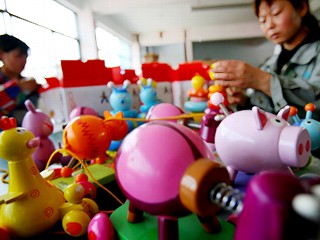
Ban on import of Chinese toys
China's manufacturing industry -- a key supplier of toys, apparel and food to much of the world -- has faced a wave of complaints in recent years, most recently as thousands of people have fallen ill as a result of consuming milk powder tainted with melamine, a chemical used to make plastics.
New Delhi, Jan. 23- The Centre on Friday banned the import of toys from China with immediate effect for six months.
The Director General of Foreign Trade issued a notification banning the imports of toys from China but did not give any reason as to why this was being done.
While the government notification did not cite the reason for the ban, sources said it was concerned over a rise in imports of toys.
A concern had also been raised over the safety of children playing with the Chinese toys, which were found to be toxic.
Most of the varieties, including wheeled toys, dolls, stuffed toys, toyguns, wooden and metal toys, musical instruments, electric trains and puzzles are covered under the ban.
The Toy Association of India's president, Raj Kumar, said the ban would severely hit imports of Chinese toys, but Indian authorities had likely taken the step in the interest of the economy.
"You see Chinese toys everywhere. The good, upper-end toys are made in India, but the cheap toys in the street and small shops were being dominated by them. They are bringing in toys without safety norms," he said.
Kumar said there had been some discussions between toy manufacturers and the government about increasing import taxes on Chinese toys, but he was not expecting a ban.
Another trade official, who did not want to be identified, said the ban may even hit imports of toy components.
"These components are used by Indian companies to make toys. Some companies that have no manufacturing facility, they only import. What will happen to them. This news has come suddenly. I'm really surprised," he said.
In the face of global downturn, Indian industry has been clamouring for protection from aggressive Chinese manufacturers.
Industry officials said there has been a surge in the import of handicraft and toys by Rs 1,000 crore during April -November 2008.
However, trade expert Arun Goyal said, "The ban would encourage smuggling of toys through Nepal borders. That would be more dangerous... It is bad, especially for the slum children, who an afford the cheap Chinese toys only."
The world's leading toymaker Mattel recalled over 21 million Chinese-made toys worldwide in 2007 due to excessive levels of lead paint and other unsafe components. Also that year, China suspended export of a bead toy that was contaminated with a "date rape" drug, Chinese media reported. Some children who swallowed the beads vomited and lost consciousness.
Relief likely for crisis-hit apparel exports sector
New Delhi, Jan. 23 The Planning Commission Deputy Chairman, Mr Montek Singh Ahluwalia, would convene a high-level meeting of different government departments on February 5.
The meeting is being called to address the core concerns of the apparel industry, particularly its export segment, badly hit by the ongoing recession in the overseas markets of developed countries, according to the Minister of State for Commerce and Power, Mr Jairam Ramesh.
Garment fair
Addressing the garment industry representatives at the ongoing India International Garment Fair in Gurgaon, Haryana, where over 350 established apparel manufacturers and exporters have been showcasing their speciality wares, Mr Ramesh said that the need for tackling the crisis in the garment industry arose out of the fact that in 2008-09, the garment exports from India would be lower than Bangladesh, while Vietnam would overtake India before long.
While India would end up exporting garments worth $8.8 billion this fiscal, Bangladesh is poised to export $12 billion worth of garments and China (excluding Hong Kong) at $115 billion.
He said that Vietnam would export $6 billion worth of garments this fiscal and would soon overtake India, if “we do not get our act together to improve the competitiveness of the Indian garment industry”.
Women workers
Considering the fact that six million people (a majority of them being women) work in the garment industry, the need for bolstering the industry in terms of safeguarding the livelihood concerns of people working in the industry assumes added significance, Mr Ramesh said.
Hence, he said, the “garment industry needs much more focused support than the real estate sector which some people have been championing”.
Earlier, in a presentation to Mr Ramesh, the Apparel Export Promotion Council Chairman, Mr Rakesh Vaid, said that all major announcements by way of fiscal stimulus measures were either a release of withheld benefits or restoration of benefits recanted lately.
He cited the case of Technology Upgradation Fund Scheme (TUFS) and Central sales tax/terminal excise duty payments and subvention of credit of 4 per cent withdrawn from October of which 2 per cent has been restored now.
He said exports in November were $621 million, a decline of 11 per cent compared withNovember 2007 and this fiscal apparel exports would be $8.78 billion, down 9.4 per cent as compared to 2007-08, he said.
Reviving activity
Pleading for a series of steps to revive activity in the crucial garment industry to help workers survive, the AEPC chief said all duty drawback rates might be notified at the rate of 14.61 per cent effective from September 2008, along with introduction of interest-free loans for investment in machinery and zero duty import of capital good scheme.
Relief likely for crisis-hit apparel exports sector
New Delhi, Jan. 23 The Planning Commission Deputy Chairman, Mr Montek Singh Ahluwalia, would convene a high-level meeting of different government departments on February 5.
The meeting is being called to address the core concerns of the apparel industry, particularly its export segment, badly hit by the ongoing recession in the overseas markets of developed countries, according to the Minister of State for Commerce and Power, Mr Jairam Ramesh.
Garment fair
Addressing the garment industry representatives at the ongoing India International Garment Fair in Gurgaon, Haryana, where over 350 established apparel manufacturers and exporters have been showcasing their speciality wares, Mr Ramesh said that the need for tackling the crisis in the garment industry arose out of the fact that in 2008-09, the garment exports from India would be lower than Bangladesh, while Vietnam would overtake India before long.
While India would end up exporting garments worth $8.8 billion this fiscal, Bangladesh is poised to export $12 billion worth of garments and China (excluding Hong Kong) at $115 billion.
He said that Vietnam would export $6 billion worth of garments this fiscal and would soon overtake India, if “we do not get our act together to improve the competitiveness of the Indian garment industry”.
Women workers
Considering the fact that six million people (a majority of them being women) work in the garment industry, the need for bolstering the industry in terms of safeguarding the livelihood concerns of people working in the industry assumes added significance, Mr Ramesh said.
Hence, he said, the “garment industry needs much more focused support than the real estate sector which some people have been championing”.
Earlier, in a presentation to Mr Ramesh, the Apparel Export Promotion Council Chairman, Mr Rakesh Vaid, said that all major announcements by way of fiscal stimulus measures were either a release of withheld benefits or restoration of benefits recanted lately.
He cited the case of Technology Upgradation Fund Scheme (TUFS) and Central sales tax/terminal excise duty payments and subvention of credit of 4 per cent withdrawn from October of which 2 per cent has been restored now.
He said exports in November were $621 million, a decline of 11 per cent compared withNovember 2007 and this fiscal apparel exports would be $8.78 billion, down 9.4 per cent as compared to 2007-08, he said.
Reviving activity
Pleading for a series of steps to revive activity in the crucial garment industry to help workers survive, the AEPC chief said all duty drawback rates might be notified at the rate of 14.61 per cent effective from September 2008, along with introduction of interest-free loans for investment in machinery and zero duty import of capital good scheme.
ASEAN-India economic integration faces difficulties
NEW DELHI, India: Most Southeast Asian countries are surrounded by bodies of water and attention so far has focused on improving port-to-port transportation. But more needs to be done before economic integration can be achieved.
There has been a proposal to set up a rail link from Delhi to Hanoi, the capital of Vietnam, passing through Myanmar, Laos, Cambodia and Thailand.
ASEAN nations and India are also working to achieve an open sky agreement, which will allow all flights to travel freely in the region.
For Southeast Asian tourists, the Indian government will soon provide multiple-entry visas.
Former ASEAN secretary-general, Ong Keng Yong, said: "Good thing is that people are thinking about the European idea - after you enter one country in Europe, you can move around. We are looking at that. But it is something we have to continuously pursue because there are so many considerations."
It takes a long time to finish customs clearances, and export and import procedures remain cumbersome, complicated and expensive. Trucks crossing international borders also require immigration controls, customs and quarantine procedures.
Singapore’s ambassador to Algeria, Zulkifli Bin Baharudin, said: "If you have 10 airports, which are well connected to the world, freedom of movement in and out of India, with the infrastructure that comes with it - custom procedures harmonised, free trade zones, understanding of manufacturing process, support of export-oriented industries - I think all that connectivity we talked about will come to fruition."
Besides infrastructure, a lack of political uniformity is also another barrier to ASEAN-India integration.
A military government in Myanmar and the recent political unrest in Thailand have obstructed the trade corridor.
Laws on taxation and banking too differ in each country. Adopting common standards and even a common currency seems unlikely as most ASEAN countries trade with India on one hand, but are also its rivals on the other hand for the import and investment of dollars in the rest of the world.
ASEAN countries have varying levels of development. This is also proving to be a hindrance in terms of developing effective infrastructure across international borders such as rail, roads and airports.
Saturday, January 3, 2009
Changes in Customs duty, Additional Customs duty rates and drawback
As part of the stimulus package announced here today, the following changes in Customs and Additional Customs duty rates, and drawback have been carried out:-
Customs and Additional Customs duty changes
On imported cement, Additional Customs duty and the special additional duty of customs [@4%] was fully exempted w.e.f 3.4.2007. This exemption has now been withdrawn. Consequently, imported cement will attract countervailing duty equal to applicable excise duty, and also special additional duty of customs @ 4%.
On zinc, customs duty was fully exempted w.e.f 29.4.2008. This exemption has been withdrawn, and the customs duty rate has been restored to the earlier rate of 5%.
On ferro-alloys, customs duty was fully exempted w.e.f 29.4.2008. Subsequently w.e.f 31.10.2008, customs duty on certain ferro-alloys, namely, ferro-molybdenum and ferro-vanadium was restored to the earlier rate of 5%. Now, the exemption provided on all other ferro-alloys has also been withdrawn, and the customs duty rate on all ferro-alloys has been restored to 5%.
On TMT (thermo-mechanically treated) bars and structurals, Additional Customs duty was fully exempted w.e.f 29.4.2008. This exemption has been withdrawn. Consequently, imported TMT bars and structurals will attract Additional Customs duty of 10%.
These changes are intended to provide a level playing field to the domestic industry. Notification No. 2/2009-Customs dated 2.1.2009 has been issued to implement these changes with immediate effect, was issued today.
Drawback changes
The drawback schedule for the financial year 2008-09 was notified with effect from 1st September, 2008. Thereafter, the Government has received several representations from exporters seeking revision in these rates, which have been examined by the Drawback Committee headed by Dr. Saumitra Chaudhury, Member, Economic Advisory Council to P.M. Based on these recommendations, the following changes are being carried out in the drawback schedule:
The drawback rates have been enhanced in respect of the following items:
a. On cotton knitted fabrics, from 4.5% to 5%;
b. On man-made knitted fabrics, from 8.7% to 8.9%;
c. On woollen knitted fabrics, from 5.7% to 5.8%; and
d. On agricultural/horticultural/forestry hand tools, from 8.5% to 10% (with a cap of Rs.7.5 per kg).
The Value cap has been enhanced in respect of the following items:
a. Cotton yarn, grey from Rs.8.00 per kg. to Rs.12.00 per kg.;
b. Complete bicycles from Rs.203 per piece to Rs. 240 per piece; and
c. Stainless steel cutlery and knives from Rs.23.50 per kg. and Rs.19.80 per kg. respectively to Rs.28.00 per kg.
In the case of texturised/twisted yarn of Polyester manufactured from partially oriented yarn (POY), on which terminal excise duty has been paid, the drawback rates are being revised to include the central excise portion.
All the above changes in drawback are being implemented with effect from 1st September, 2008. Drawback will henceforth be also allowed on boots/half boots/shoes of leather cum synthetic/textile materials at 10.5% subject to a value cap of Rs.110 per pair. The details of these changes are contained in the relevant Notifications being issued today.
